What a geomagnetic storm is, and what it can disrupt on Earth
Bursts of solar activity can disturb satellites, GPS and power grids. NOAA rates the strength of these storms on a five-level scale.
Reviewed by Jackson on 2026-11-07.
Quick answer
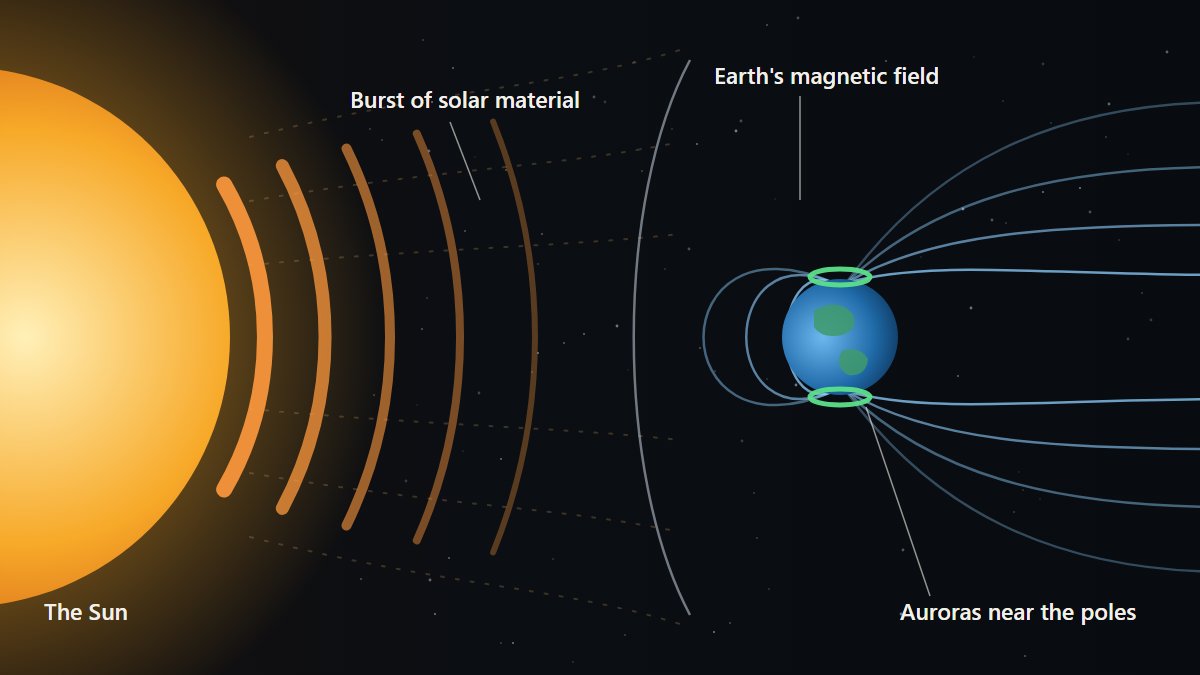
A geomagnetic storm is a major disturbance of Earth's magnetosphere, caused by energy from the solar wind. Strong storms can affect satellites, GPS and power grids, and can push auroras farther from the poles.[2][3]
Key points
- NOAA's forecast issued November 7, 2026, expects minor G1 storm levels on November 7-9, with a chance of moderate G2 levels.[1]
- A geomagnetic storm is a major disturbance of Earth's magnetosphere, driven by energy from the solar wind.[2]
- The largest storms come from coronal mass ejections, which usually take several days to reach Earth.[2]
- Technology at risk includes satellites, power grids, pipelines, radio networks and satellite navigation.[4]
- NOAA's scale runs from G1 to G5. It lists G5 storms, the most extreme, at about four per 11-year solar cycle.[3]
Why it matters
Daily life depends on the systems these storms can disturb. The British Geological Survey points to satellites, power grids, pipelines, communications networks and satellite navigation, and says society increasingly relies on them.[4]
The forecast for November 7-9, 2026
NOAA's forecast attributes the expected activity to a high-speed solar wind stream from a coronal hole. It says the strongest period is expected late on November 8, in Universal Time. Activity stayed below storm levels in the 24 hours before the forecast was issued.[1]
NOAA's scale describes G1 storms as causing weak power grid fluctuations and possible minor effects on satellites, with auroras commonly visible at high latitudes such as northern Michigan and Maine. At G2, auroras have been seen as far south as New York and Idaho.[3]
How a storm starts
Earth's magnetosphere is the region of space shaped by the planet's magnetic field. A storm happens when the solar wind transfers energy into it very efficiently. NOAA says the most effective conditions are sustained periods of fast solar wind, and above all a southward solar wind magnetic field, which points opposite to Earth's own field on the side facing the Sun.[2]
The biggest storms follow coronal mass ejections, when about a billion tons of plasma from the Sun reach Earth with their magnetic field. They typically take several days to arrive, though NOAA reports arrivals in as little as 18 hours during some of the most intense storms. High-speed solar wind streams also cause storms. These are less intense but can deposit more energy over a longer period.[2]
What can be affected
The British Geological Survey lists satellites, power grids, oil and gas pipelines, radio and telephone networks, and satellite navigation among the systems space weather can threaten. It also notes the implications for crewed spaceflight.[4]
NOAA describes two effects in more detail. Heating can increase the density of the upper atmosphere, adding drag on satellites in low orbit. Uneven density in the ionosphere can also bend radio signals and create GPS positioning errors.[2]
How strength is measured
NOAA uses a G-scale based on the Kp index, a planetary measure of magnetic disturbance. At the extreme G5 level, NOAA says some grids may collapse or black out and satellite navigation may degrade for days. Auroras have been seen as far south as Florida and southern Texas.[2][3]
Two levels lower, NOAA lists G3 storms at about 200 per solar cycle. Those can trigger false alarms on some power protection devices and cause intermittent navigation problems. Auroras have been seen as far south as Illinois and Oregon at this level.[3]
G1: Minor
- Power
- Weak grid fluctuations can occur.
- Satellites
- Minor effects on operations are possible.
- Auroras
- Commonly visible at high latitudes, such as northern Michigan and Maine.
G2: Moderate
- Power
- Voltage alarms at high latitudes. Long-lasting storms may damage transformers.
- Satellites
- Ground control may need to correct orientation, and drag changes can affect orbit predictions.
- Radio
- High-frequency radio can fade at higher latitudes.
- Auroras
- Seen as far south as New York and Idaho.
G3: Strong
- Power
- Voltage corrections may be needed, with false alarms on some protection devices.
- Satellites
- Surface charging may occur, drag may rise in low orbit, and orientation may need correcting.
- Navigation and radio
- Intermittent problems with satellite navigation, low-frequency navigation and high-frequency radio.
- Auroras
- Seen as far south as Illinois and Oregon.
G4: Severe
- Power
- Possible widespread voltage problems. Some protective systems may mistakenly take key equipment off the grid.
- Satellites
- Surface charging and tracking problems, and orientation may need correcting.
- Navigation and radio
- Satellite navigation degraded for hours, low-frequency navigation disrupted, and high-frequency radio sporadic.
- Auroras
- Seen as far south as Alabama and northern California.
G5: Extreme
- Power
- Widespread voltage and protection problems. Some grids may collapse or black out, and transformers may be damaged.
- Satellites
- Extensive surface charging, with orientation, communication and tracking problems.
- Navigation and radio
- High-frequency radio may be impossible in many areas for one to two days, and satellite navigation may be degraded for days.
- Auroras
- Seen as far south as Florida and southern Texas.
What you can do
- Check NOAA's Space Weather Prediction Center for the latest outlook. It issues its three-day forecast every 12 hours.[5]
- Hoping to see an aurora? Use the storm level in the forecast with the scale above to get a rough idea of how far south auroras have been seen.[3]
What we don't know yet
- How any particular storm will affect a specific place. Forecasts can change, and NOAA issues this one every 12 hours, so check its Space Weather Prediction Center for the latest.
What changed
- 2026-11-07: First version, including NOAA's forecast for November 7-9, 2026.
Sources
- NOAA Space Weather Prediction Center: 3-Day Forecast, issued 2026 Nov 07 1230 UTC (accessed 2026-11-07)
- NOAA Space Weather Prediction Center: Geomagnetic Storms (accessed 2026-11-07)
- NOAA Space Weather Prediction Center: NOAA Space Weather Scales (accessed 2026-11-07)
- British Geological Survey: Space Weather and Geomagnetic Hazard (accessed 2026-11-07)
- NOAA Space Weather Prediction Center: 3-Day Forecast (accessed 2026-11-07)